

Image Details
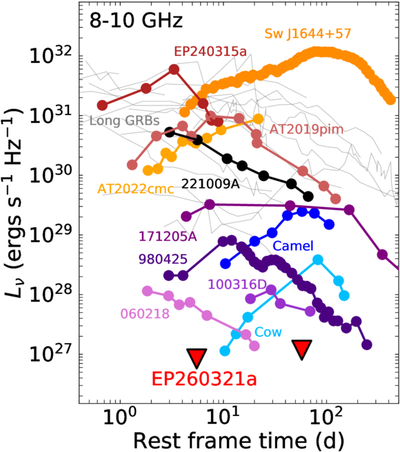
Caption: Figure 16.
Comparison between the radio upper limits for EP260321a (downward red triangles) versus the radio luminosity of multiple classes of energetic transients, including GRBs (A. M. Soderberg et al. 2006; P. Chandra & D. A. Frail 2012; T. Laskar et al. 2022; D. A. Perley et al. 2025; R. Ricci et al. 2025), jetted tidal disruption events (B. A. Zauderer et al. 2011; I. Andreoni et al. 2022), and fast blue optical transients (A. Y. Q. Ho et al. 2019, 2020; R. Margutti et al. 2019; D. L. Coppejans et al. 2020). The figure is reproduced from B. O’Connor et al. (2025b).
Other Images in This Article
Show More
Copyright and Terms & Conditions
© 2026. The Author(s). Published by the American Astronomical Society.

Copyright ©
2026 Astronomy Image Explorer. All Rights Reserved.
