

Image Details
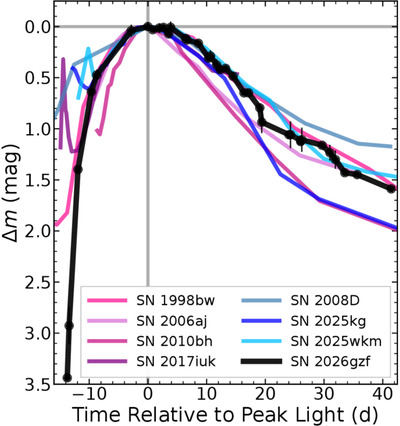
Caption: Figure 3.
Lightcurve shape relative to peak brightness for SN 2026gzf (black) versus GRB-SNe (SNe 1998bw, 2006aj, 2010bh, and 2017iuk; T. J. Galama et al. 1998; S. Campana et al. 2006b; J. Sollerman et al. 2006; R. L. C. Starling et al. 2011; V. D’Elia et al. 2018; L. Izzo et al. 2019) and FXT-SNe (SNe 2008D, 2025 kg and 2025wkm; A. M. Soderberg et al. 2008; R. A. J. Eyles-Ferris et al. 2025; J. C. Rastinejad et al. 2025; G. P. Srinivasaragavan et al. 2025a, 2025b). The data are presented in either the r or R filters, and time has been converted to the rest frame.
Other Images in This Article
Show More
Copyright and Terms & Conditions
© 2026. The Author(s). Published by the American Astronomical Society.

Copyright ©
2026 Astronomy Image Explorer. All Rights Reserved.
