

Image Details
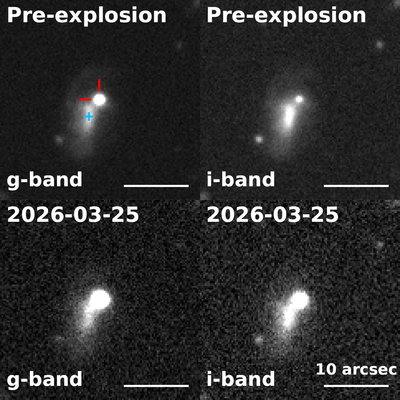
Caption: Figure 1.
Finding chart of EP260321a/SN 2026gzf using DECam imaging in the g and i filters. Archival pre-explosion DECam images from 2013 (13 yr before discovery) are shown in the top panels, while the bottom panels show imaging obtained on 2026 March 25 (T0 + 3.6 days). A blue point source (g − i ≈ −1.3 mag) is visible at the location of the transient in archival imaging (see Appendix C). The transient explosion site (red crosshairs) is offset by 3﹩\mathop{.}\limits^{{\unicode{x02033}}}﹩4 from the center of the host galaxy (blue cross), corresponding to 2.5 kpc at z = 0.0344.
Other Images in This Article
Show More
Copyright and Terms & Conditions
© 2026. The Author(s). Published by the American Astronomical Society.

Copyright ©
2026 Astronomy Image Explorer. All Rights Reserved.
