

Image Details
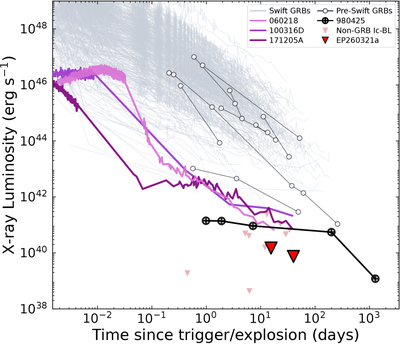
Caption: Figure 15.
Observer-frame X-ray afterglow (0.3–10 keV) lightcurves of GRBs and FXTs. The X-ray upper limits from Chandra for EP260321a are shown as downward red triangles. For comparison, we show both long and short GRBs (gray) from Swift (P. A. Evans et al. 2007, 2009), and specifically highlight a sample of low-luminosity GRBs. Additional X-ray data for GRBs 060218 and 100316D are compiled from A. M. Soderberg et al. (2006) and R. Margutti et al. (2013a). Pre-Swift GRB and XRF X-ray afterglows are reproduced from E. Pian et al. (1999, 2000, 2004), C. Kouveliotou et al. (2004), A. Tiengo et al. (2004), D. Watson et al. (2004) and references therein. X-ray upper limits for non-GRB-associated SNe Ic-BL (orange downward triangles) were obtained from T. O’Dwyer et al. (2026).
Other Images in This Article
Show More
Copyright and Terms & Conditions
© 2026. The Author(s). Published by the American Astronomical Society.

