

Image Details
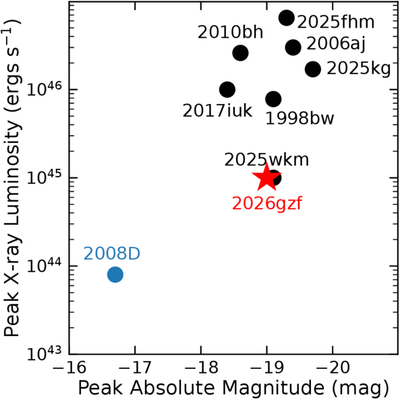
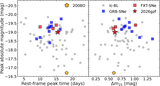
Caption: Figure 13.
X-ray luminosity vs. peak absolute magnitude of SN shock breakout candidates detected by Swift (GRB 980425/SN 1998bw; GRB 060218/SN 2006aj; XRF 080109/SN 2008D; GRB 100316D/SN 2010bh; GRB 171205A/SN 2017iuk) and the EP (EP250108a/SN 2025kg; EP250827b/SN 2025wkm). EP260321a/SN 2026gzf is shown as a red star (W. Yuan et al. 2026). SN Ic-BL are shown as black circles. SN 2008D, an SN Ib, is shown as a blue circle. Data have been taken from T. J. Galama et al. (1998), A. M. Soderberg et al. (2006, 2008), R. L. C. Starling et al. (2011), Z. Cano et al. (2011), L. Izzo et al. (2019), W. X. Li et al. (2025), J. C. Rastinejad et al. (2025), G. P. Srinivasaragavan et al. (2025a, 2025b), and L. Cotter et al. (2026). This figure is reproduced from J. C. Rastinejad et al. (2025) with the addition of newer EP events (SNe 2025wkm and 2026gzf). Here, we have utilized the dust-corrected absolute magnitudes of SN 2008D and SN 2010bh.
Other Images in This Article
Show More
Copyright and Terms & Conditions
© 2026. The Author(s). Published by the American Astronomical Society.

