

Image Details
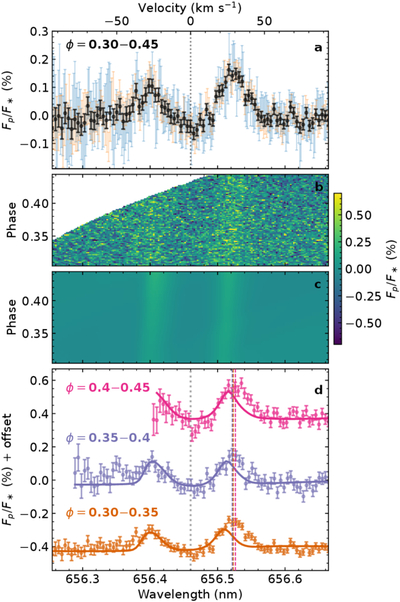
Caption: Figure 1.
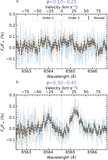
Hα emission line in KELT-9 b. (a) Phase-averaged Hα emission over ϕ = 0.30–0.45. The double-peaked emission with central self-absorption is detected at 10σ. Blue and orange points show the two independent spectral orders; black points are binned fluxes in every five data points. (b) 2D time-series Hα spectra in the planet’s rest frame; the two emission peaks appear in slanted bright yellow traces. Wavelengths contaminated by stellar pulsation are masked, which led to the data truncation on the top left. (c) Synthetic 2D time-series model spectra. The peak locations shift redward by ∼3.8 km s−1 from the bottom to the top. (d) Observed and modeled spectra averaged in three phase bins (0.30–0.35, 0.35–0.40, and 0.40–0.45). The gray dotted line is the central wavelength of Hα. The colored vertical dashed lines annotate the red peak’s location for each phase bin. The model reproduces the progressive redshift of the peaks with phase, driven by planetary rotation and day-to-night winds.
Other Images in This Article
Copyright and Terms & Conditions
© 2026. The Author(s). Published by the American Astronomical Society.

