

Image Details
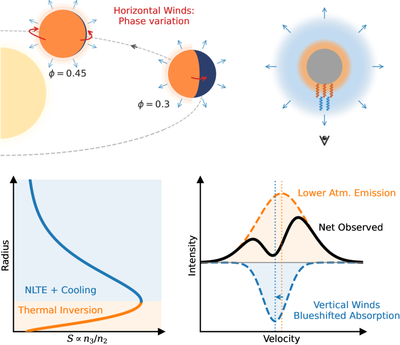
Caption: Figure 3.
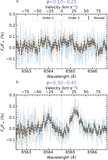
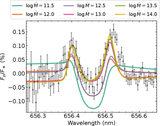
Physical origin of the double-peaked Hα emission. The hot (>4500 K) lower atmosphere shows a thermal inversion and emits in Hα (orange). The extended upper atmosphere has a decreasing source function (n3/n2) and a temperature fall-off due to NLTE effects and expansion cooling, and absorbs the line core (blue). The vertical outflow wind blueshifts the absorbing layer relative to the emitting layer, producing asymmetric double peaks. Horizontal day-to-night winds advect gas away from the observer as the dayside hemisphere rotates into view, producing the progressive redshift with orbital phase.
Other Images in This Article
Copyright and Terms & Conditions
© 2026. The Author(s). Published by the American Astronomical Society.

Copyright ©
2026 Astronomy Image Explorer. All Rights Reserved.
