

Image Details
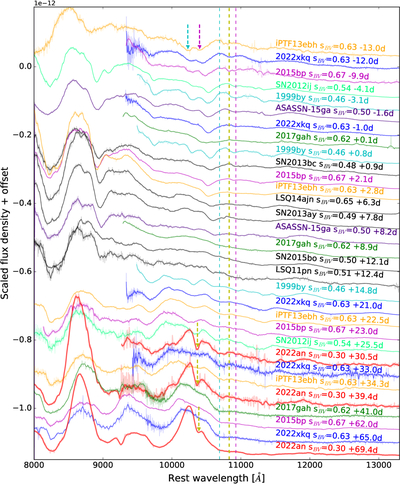
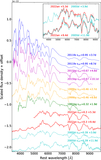
Caption: Figure 12.
NIR spectra of SN 2022an compared with those of fast-declining SNe Ia with sBV < 0.7. The vertical dashed lines show the rest-frame wavelengths of C I 1.069 μm, He I 1.083 μm, and Mg II 1.0927 μm in cyan, yellow, and magenta, respectively. The magenta arrow indicates the absorption feature commonly attributed to the Mg II 1.0927 μm line in the literature. The cyan arrow indicates an absorption feature with ambiguous identification, potentially corresponding to either C I 1.069 μm or He I 1.083 μm. The yellow arrows mark the feature identified as He I 1.083 μm absorption in SN 2022an. The spectra are sorted by phase relative to the B-band peak, which is labeled after each object name together with the color-stretch parameter sBV. The comparison objects include iPTF13ebh (E. Y. Hsiao et al. 2015), SN 2022xkq (J. Pearson et al. 2024), SN 2015bp (S. D. Wyatt et al. 2021), SN 2012ij (Z. Li et al. 2022), SN 1999by (P. Höflich et al. 2002; P. M. Garnavich et al. 2004), ASASSN-15ga (J. Lu et al. 2023), SN 2017gah (S. J. Smartt et al. 2015; P. Chen et al. 2022), SN 2013bc (J. Lu et al. 2023), LSQ14ajn (J. Lu et al. 2023), SN 2013ay (J. Lu et al. 2023), SN 2015bo (J. Lu et al. 2023), and LSQ11pn (J. Lu et al. 2023).
Other Images in This Article
Show More
Copyright and Terms & Conditions
© 2026. The Author(s). Published by the American Astronomical Society.

