

Image Details
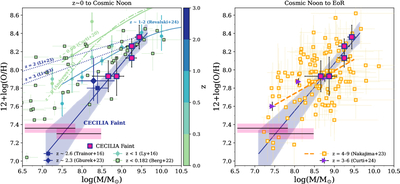
Caption: Figure 7.
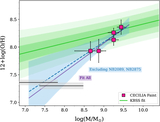
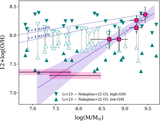
Left: redshift evolution of the low-mass MZR from z ∼ 0 to Cosmic Noon. At low redshift, we show the SDSS-based relations of B. H. Andrews & P. Martini (2013; z ∼ 0, dash–dotted line) and M. Curti et al. (2020; z ∼ 0.08, solid line), together with individual CLASSY galaxies (z < 0.18; squares). Galaxies from the MACT survey (C. Ly et al. 2016; circles) trace the decline in metallicity toward z < 1, while the relation from M. Revalski et al. (2024; solid line) extends this trend to z ∼ 1–2. At redshifts comparable to our sample, we include the stacked measurement at z ∼ 2.6 from R. F. Trainor et al. (2016; square), the lensed dwarf galaxy stack of T. Gburek et al. (2023; diamond), and the MZR fits at z ∼ 2 and z ∼ 3 from M. Li et al. (2023; dotted lines). The CECILIA Faint galaxies are shown with a pink fill. Colors indicate the average redshift of each sample, ranging from green at low redshift to dark blue at Cosmic Noon. Right: MZR from Cosmic Noon to the Epoch of Reionization (EoR). At higher redshifts (z > 3), we show stacked measurements from M. Curti et al. (2024; purple triangles), the CEERS/NIRSpec MZR fit of K. Nakajima et al. (2023; orange dashed line), as well as their individual galaxy measurements (yellow squares). Overall, metallicity at fixed stellar mass decreases with increasing redshift, reflecting progressively less chemically enriched systems, while the slope of the MZR exhibits little evolution. Beyond Cosmic Noon, no significant evolution in the normalization of the MZR is apparent.
Other Images in This Article
Copyright and Terms & Conditions
© 2026. The Author(s). Published by the American Astronomical Society.

