

Image Details
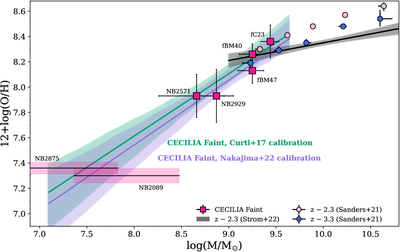
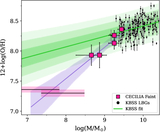
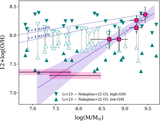
Caption: Figure 4.
MZR for our CECILIA Faint sample (pink squares and shaded rectangles as in Figure 2), with gas-phase metallicities ﹩12+\mathrm{log}({\rm{O}}/{\rm{H}})﹩ derived using the O3-based calibration of K. Nakajima et al. (2022). The solid purple line shows the best-fit linear relation from our MCMC analysis, with the shaded region indicating the 1σ uncertainty. The slope inferred using the M. Curti et al. (2017) calibration is shown in teal for comparison. Our measurements are compared with stacked spectra at z ∼ 2.3 and z ∼ 3.3 from R. L. Sanders et al. (2021, pink and blue circles, respectively), and with the KBSS relation determined using photoionization models (A. L. Strom et al. 2022; black line and gray shaded region). Both MOSDEF and KBSS are consistent with our highest-mass (M⋆ > 109 M⊙) CECILIA Faint galaxies. The two strong-line calibrations (M. Curti et al. 2017; K. Nakajima et al. 2022) agree within their 1σ uncertainties, highlighting that the steeper slope we observe at low masses is not driven by the choice of calibration.
Other Images in This Article
Copyright and Terms & Conditions
© 2026. The Author(s). Published by the American Astronomical Society.

