

Image Details
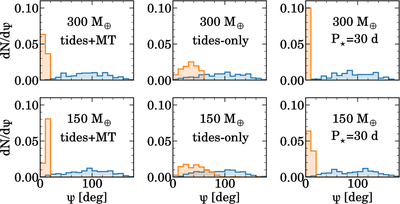
Caption: Figure 5.
Stellar obliquity (ψ⋆) distributions sculpted by Roche-lobe overflow. Blue histograms (﹩\cos {\psi }_{\star }﹩ uniformly sampled in [-1,1]) are processed by Roche-lobe overflow into the orange distributions. We adjust the initial angular momentum budget for each ensemble by varying initial planet mass and stellar rotation period. Leftmost panels use an initial stellar rotation period P⋆ = 5 days, and assume perfect transfer of angular momentum during mass transfer (β = 1; “tides+MT”). Middle panels isolate the effect of tidal alignment during orbital inspiral by ignoring angular momentum transfer due to Roche-lobe overflow (β = 0). Rightmost panels are the same as the leftmost, except they use an initially slowly rotating host star with P⋆ = 30 days. Tides and angular momentum transfer ensure that all roads lead to Rome: Roche-lobe overflow robustly predicts that stellar spins are aligned within ∼a few tens of degrees with the orbits of remnant planets.
Other Images in This Article
Copyright and Terms & Conditions
© 2026. The Author(s). Published by the American Astronomical Society.

