

Image Details
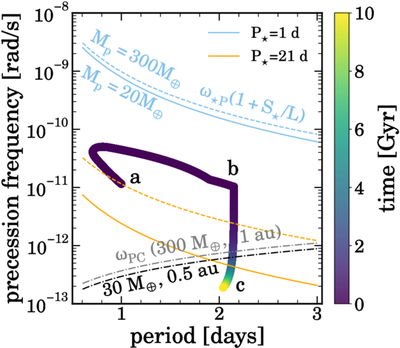
Caption: Figure 6.
Precession frequency evolution versus orbital period following mass transfer. Following D. Lai et al. (2018), when torque from an external planet disrupts star–inner planet precession (ω⋆P(1 + S⋆/L) ∼ ωPC), the inner planet’s obliquity may be excited. Blue and orange curves depict ω⋆P(1 + S⋆/L) for fast and slow rotating stars (see the legend), while dashed and solid curves correspond to 300 and 20 M⊕ inner planets, respectively. The gray and black dotted–dashed curves denote the planet–planet precession frequency for differing external companion parameters (labeled). The colored curve, color bar, and points a, b, and c depict an example of ω⋆P(t)(1 + S⋆(t)/L(t)) evolution during mass transfer; the example planet begins at period ∼1 day (point a) before bouncing out to ∼2 days after Roche-lobe overflow (point b), after which the star spins down via magnetic braking (point c). Stellar spin-down permits orbit tilting when ω⋆P(1 + S⋆/L) ∼ ωPC ∼ 8 × 10⁻¹³ rad s−1 (between b and c). Hot Jupiter remnants’ obliquities can be excited by (as yet unseen) companion planets.
Other Images in This Article
Copyright and Terms & Conditions
© 2026. The Author(s). Published by the American Astronomical Society.

