

Image Details
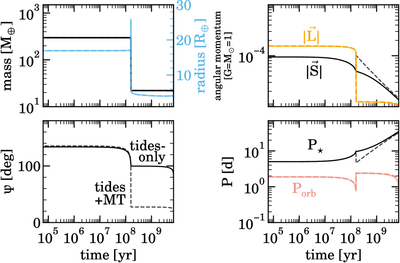
Caption: Figure 2.
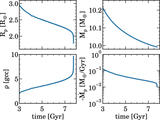
Dynamical evolution of a star–hot Jupiter system through Roche-lobe overflow. From top to bottom, left panels depict: planet mass (left axis; black) and radius (right axis; blue), and obliquity. From top to bottom, right panels show: angular momenta in natural units (orbital angular momentum in orange, stellar spin angular momentum in black) and period (orbital in salmon, stellar spin in black). Solid curves assume that only tides transfer orbital angular momentum to the star (β = 0; labeled “tides-only”), while dashed curves include angular momentum transfer during Roche-lobe overflow (β = 1; “tides+MT”). Assuming angular momentum transfer during Roche-lobe overflow is modulated by the Alfvén radius (β(RA)) yields an intermediate obliquity between the tides-only and tides+MT curves. This example employs Q⋆ = 104, initial planet entropy S = 9.5 kB/mH, and a solar composition planetary atmosphere. Planet structure and mass-loss calculations follow T. Hallatt & S. Millholland (2026a). Stellar obliquity is damped below ≲25° by mass transfer (for β = 1, or <45° when using β(RA)), not tides (β = 0), when initial stellar spin and orbital angular momenta are commensurate.
Other Images in This Article
Copyright and Terms & Conditions
© 2026. The Author(s). Published by the American Astronomical Society.

