

Image Details
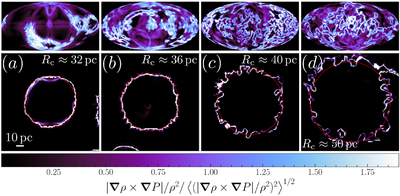
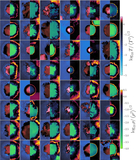
Caption: Figure 4.
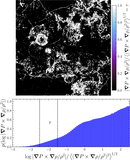
Evolution of the unstable thin shell traced by ∇ρ × ∇P/ρ2 in the SNR. Each column from (a) to (d) shows the SNR at an increasing radius, Rc (∼age; indicated in red in the bottom row), all taken from the same early-time realization of the global simulation to ensure that only internal instabilities impact the layer. As the shell expands, high-k modes grow in the layer. By the time it reaches the full 125 pc domain size, the shell has become highly fractal, with deep, folded corrugations, without any background inhomogeneities to enhance or modify the unstable modes. Top row: the ∇ρ × ∇P/ρ2 “sky” for an observer at the center of the SNR, sliced at the radius, Rc, highlighted in red in the bottom row, qualitatively showing that high-order spherical harmonics become increasingly excited as the SNR expands. Bottom row: 2D slices of ∇ρ × ∇P/ρ2 (the same as in Figure 1), showing the evolving, expanding corrugated layer.
Other Images in This Article

Show More
Copyright and Terms & Conditions
© 2026. The Author(s). Published by the American Astronomical Society.

