

Image Details
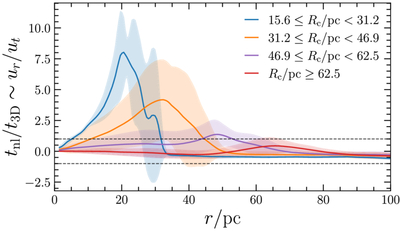
Caption: Figure 12.
The ratio between the 2D nonlinear timescale, tnl = 1/(k⊥ut), and the 3D vortex stretching timescale, t3D ∼ 1/(k⊥ur), where k⊥ are modes on the surface of the contact discontinuity, ut is the turbulent component of the velocity in the transverse plane to the surface, and ur is the radial velocity (a compressible mode), penetrating through the unstable layer (discussed in Section 4.1). Each line represents a different population of SNRs, binned by the radius of the contact discontinuity, Rc (∼age). The ±1 is indicated with the black dashed lines. For tnl/t3D > 1, the modes generated on the surface shed into the surrounding medium through vortex stretching. For tnl/t3D < 1, the modes are confined to interact (and potentially cascade) on the surface. Old SNRs may become confined owing to the decaying ur, whereas young SNRs can efficiently radiate the turbulence that develops at the contact discontinuity.
Other Images in This Article
Show More
Copyright and Terms & Conditions
© 2026. The Author(s). Published by the American Astronomical Society.

