

Image Details
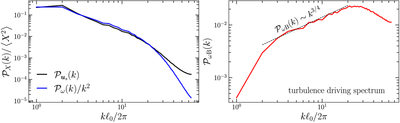
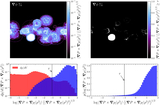
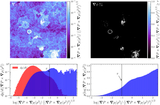
Caption: Figure 11.
Left: the same as Figure 3, but for the incompressible velocity-mode spectrum, ﹩{{ \mathcal P }}_{{{\boldsymbol{u}}}_{s}}(k)﹩ (black), and the vorticity spectrum, ﹩{{ \mathcal P }}_{\omega }(k)﹩ (blue). ﹩{{ \mathcal P }}_{\omega }(k)﹩ is compensated by k2 to test the canonical prediction ﹩{{ \mathcal P }}_{{{\boldsymbol{u}}}_{s}}(k)\sim {k}^{2}{{ \mathcal P }}_{\omega }(k)﹩. The spectra are averaged over all SNRs. For modes with wavelengths larger than the diffusion-dominated scales (kℓ0/2π ≲ 10), the two spectra correspond almost perfectly, as expected, implying ﹩{{ \mathcal P }}_{\omega }(k)\propto {k}^{1/2}﹩. Right: the baroclinicity and vorticity cospectrum Equation (2), ﹩{{ \mathcal P }}_{\omega B}(k)﹩, i.e., the spectrum that probes the flux interaction between ∇ρ × ∇P/ρ2 and ω. The ﹩{{ \mathcal P }}_{\omega B}(k)\propto {k}^{3/4}﹩ relation, showing a perfect match to the spectrum, comes from my prediction for a ﹩{{ \mathcal P }}_{{{\boldsymbol{u}}}_{s}}(k)\propto {k}^{-3/2}﹩ spectrum that is sourced completely from ω · (∇ρ × ∇P/ρ2), Equation (7).
Other Images in This Article
Show More
Copyright and Terms & Conditions
© 2026. The Author(s). Published by the American Astronomical Society.

