

Image Details
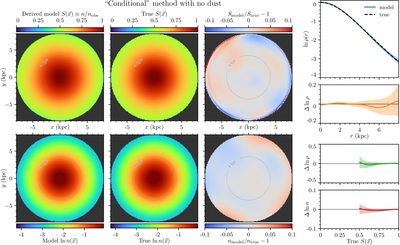
Caption: Figure 6.
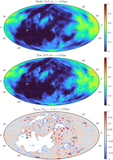
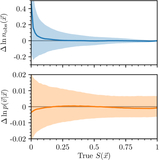
Performance of the conditional Deep Potential method on the dust-free Plummer sphere. Top row, left three panels: the derived selection function, defined as ﹩S\left({\boldsymbol{x}}\right)\equiv n\left({\boldsymbol{x}}\right)/{n}_{{\rm{obs}}}\left({\boldsymbol{x}}\right)﹩; the true selection function; and the fractional residuals, shown in a two-dimensional slice through the z = 0 plane. The derived selection function is expected to behave almost identically to the “selection function” method of Deep Potential. Bottom row, left three panels: the recovered true spatial density of tracers ﹩\mathrm{ln}n\left({\boldsymbol{x}}\right)﹩; the ground truth; and the fractional residuals. Both Smodel and nmodel are recovered to within ∼5% throughout the volume and do not exhibit any fine angular structure, unlike for the dusty Plummer sphere. Right column, from top to bottom: the median gravitational density ﹩\mathrm{ln}\rho =\mathrm{ln}({{\rm{\nabla }}}^{2}{\rm{\Phi }}/(4\pi G))﹩ as a function of r; residuals ﹩{\rm{\Delta }}\mathrm{ln}\rho ﹩ as a function of r; residuals ﹩{\rm{\Delta }}\mathrm{ln}\rho ﹩ as a function of the true ﹩S\left({\boldsymbol{x}}\right)﹩; and residuals ﹩{\rm{\Delta }}\mathrm{ln}n﹩ as a function of the true ﹩S\left({\boldsymbol{x}}\right)﹩. The clipping in the last two plots is caused by the selection function being greater than ∼0.5 throughout the volume. The shaded regions enclose the 16th and 84th percentiles. Compare to Figures 2 and 3, which show results obtained for a dusty Plummer sphere.
Other Images in This Article
Copyright and Terms & Conditions
© 2026. The Author(s). Published by the American Astronomical Society.

