

Image Details
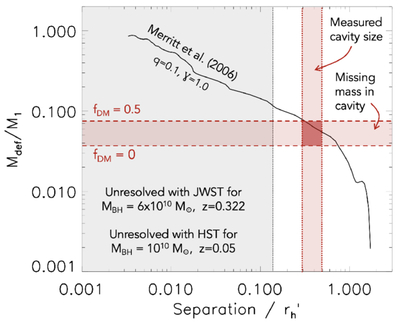
Caption: Figure 6.
An example simulation from D. Merritt (2006) showing the amount of mass in stars and dark matter scattered to larger radius during three-body encounters from a binary SMBH as a function of binary separation—both axes are scaled by a scale factor related to the mass of the binary, making this prediction mass independent. The simulation shown is for a 10:1 (q = 0.1) binary in a galaxy with a slight stellar cusp (γ = 1.0), which was the only parameter set shown in D. Merritt (2006) and is used here for illustrative purposes. While, eventually, the amount of missing mass approaches the total mass of the binary, the missing mass is expected to be closer to 10% for measurable separations in black holes with M > 1010 M⊙. For the central galaxy in A402, we measure a stellar mass deficit of 2 × 10⁹ M⊙, which could be a factor of ∼2 higher for realistic dark matter fractions in the centers of elliptical galaxies (M. W. Auger et al. 2010; M. Barnabè et al. 2011). Coupling this with the measured separation (1.2 ± 0.3 kpc), and normalizing these to the primary SMBH mass (M1) and the gravitational sphere of influence (﹩{r}_{h}^{\prime} ﹩), we find excellent agreement with theory.
Other Images in This Article
Copyright and Terms & Conditions
© 2026. The Author(s). Published by the American Astronomical Society.

