

Image Details
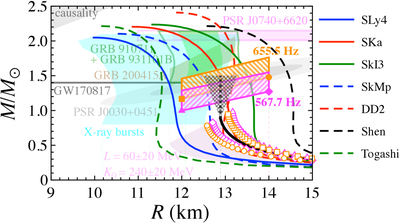
Caption: Figure 6.
The mass and radius of FRB 20240114A, constrained from the identification of the QPO frequencies with the crustal torsional oscillations, together with the constraint on the nuclear parameter obtained from the terrestrial experiments, are shown with the shaded regions with hashed lines, where the shaded region with hashed lines from top left to bottom right (with hashed lines from top right to bottom left) is the allowed region with the identification of the 655.5 Hz (567.7 Hz) with the first overtone. The sequences with open circles, open squares, open diamonds, and open triangles denote the NS mass and radius estimated from the low-mass formula (H. Sotani et al. 2014), using the same values of L and K0 for the stellar models marked with the filled circle, filled square, filled diamond, and filled triangle, respectively. For reference, we also show the other astronomical constraints on the NS mass and radius for PSR J0030+0451, PSR J0740+6620, GW170817, GRB 200415A, a combination of GRB 910711 and GRB 931101B and x-ray bursts; the theoretical constraint from causality; and the expected mass and radius from the fiducial values of L and K0 constrained from the experiments (see text for details). In addition, the stellar models shown with a black solid line are the low-mass NS sequence, assuming L = 74 MeV, which is a median value for the stellar models shown with open diamonds and squares, while the black dotted line is just an extension of the black solid line by fixing the radius (R = 12.9 km).
Other Images in This Article
Copyright and Terms & Conditions
© 2026. The Author(s). Published by the American Astronomical Society.

