Image Details

Choose export citation format:

Early Spectroscopy and Dense Circumstellar Medium Interaction in SN 2023ixf

  • Authors: K. Azalee Bostroem, Jeniveve Pearson, Manisha Shrestha, David J. Sand, Stefano Valenti, Saurabh W. Jha, Jennifer E. Andrews, Nathan Smith, Giacomo Terreran, Elizabeth Green, Yize Dong, 一泽 董, Michael Lundquist, Joshua Haislip, Emily T. Hoang, Griffin Hosseinzadeh, Daryl Janzen, Jacob E. Jencson, Vladimir Kouprianov, Emmy Paraskeva, Nicolas E. Meza Retamal, Daniel E. Reichart, Iair Arcavi, Alceste Z. Bonanos, Michael W. Coughlin, Ross Dobson, Joseph Farah, Lluís Galbany, Claudia Gutiérrez, Suzanne Hawley, Leslie Hebb, Daichi Hiramatsu, D. Andrew Howell, Takashi Iijima, Ilya Ilyin, Kiran Jhass, Curtis McCully, Sean Moran, Brett M. Morris, Alessandra C. Mura, Tomás E. Müller-Bravo, James Munday, Megan Newsome, Maria Th. Pabst, Paolo Ochner, Estefania Padilla Gonzalez, Andrea Pastorello, Craig Pellegrino, Lara Piscarreta, Aravind P. Ravi, Andrea Reguitti, Laura Salo, József Vinkó, Kellie de Vos, J. C. Wheeler, G. Grant Williams, Samuel Wyatt

K. Azalee Bostroem et al 2023 The Astrophysical Journal Letters 956 .

  • Provider: AAS Journals

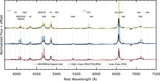
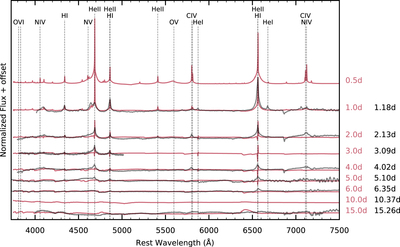
Caption: Figure 5.

A comparison of the spectral evolution of SN 2023ixf (black) to the r1w4 model of Dessart et al. (2017; pink). Phases are shown to the right of the figure in pink for the model and black from the observed spectra. While the first observation at 1.2 days matches fairly well, the model spectra evolve much more rapidly, with P Cygni profiles developing at day 2 and all emission disappearing by day 4, while the observations show emission through days 6–7. The model spectrum at 0.5 day shows a number of lines that have faded by 1 day (e.g., N V).

Other Images in This Article
Copyright and Terms & Conditions

Additional terms of reuse