

Image Details
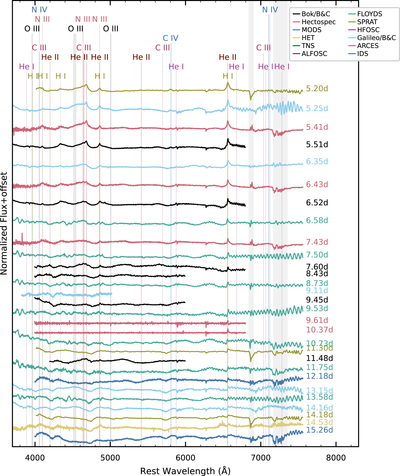
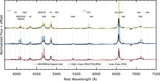
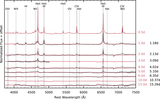
Caption: Figure 1.
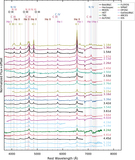
(a) The evolution of the optical spectra of SN 2023ixf over the first ∼5.2 days, with the earliest epoch at the top of the figure. Spectra are color coded by the instrument used to observe them, normalized by a blackbody fit, and corrected for redshift. Emission lines are identified at their rest wavelengths with vertical lines and labeled at the top of the figure, while the most prominent telluric features are marked with the shaded gray region. Throughout this sequence, the spectra evolve from showing strong, narrow emission lines from high-ionization species to intermediate width features as the CSM is accelerated by the shock. The spectra evolve rapidly between 1.18 and 1.67 days, with the He I and N III (λλ4634.0,4640.6)/C III (λλ4647.5,4650.0) lines disappearing within the first 0.5 day from the first spectrum while He II (λ4685.5), N IV, and C IV gain strength. (b) Continuation of Figure 1 showing the evolution of the optical spectra of SN 2023ixf from days 5.2 to 14.5 with the earliest epoch at the top of the figure. Over the first 7 days, the spectra evolve from showing strong, narrow emission lines from high-ionization species to a nearly featureless spectrum with an intermediate with P Cygni profile in Hα. In the subsequent 7 days, broad P Cygni profiles develop in the higher-order Balmer features.
Other Images in This Article
Copyright and Terms & Conditions
© 2023. The Author(s). Published by the American Astronomical Society.

Copyright ©
2026 Astronomy Image Explorer. All Rights Reserved.
