Image Details

Choose export citation format:

Early Spectroscopy and Dense Circumstellar Medium Interaction in SN 2023ixf

  • Authors: K. Azalee Bostroem, Jeniveve Pearson, Manisha Shrestha, David J. Sand, Stefano Valenti, Saurabh W. Jha, Jennifer E. Andrews, Nathan Smith, Giacomo Terreran, Elizabeth Green, Yize Dong, 一泽 董, Michael Lundquist, Joshua Haislip, Emily T. Hoang, Griffin Hosseinzadeh, Daryl Janzen, Jacob E. Jencson, Vladimir Kouprianov, Emmy Paraskeva, Nicolas E. Meza Retamal, Daniel E. Reichart, Iair Arcavi, Alceste Z. Bonanos, Michael W. Coughlin, Ross Dobson, Joseph Farah, Lluís Galbany, Claudia Gutiérrez, Suzanne Hawley, Leslie Hebb, Daichi Hiramatsu, D. Andrew Howell, Takashi Iijima, Ilya Ilyin, Kiran Jhass, Curtis McCully, Sean Moran, Brett M. Morris, Alessandra C. Mura, Tomás E. Müller-Bravo, James Munday, Megan Newsome, Maria Th. Pabst, Paolo Ochner, Estefania Padilla Gonzalez, Andrea Pastorello, Craig Pellegrino, Lara Piscarreta, Aravind P. Ravi, Andrea Reguitti, Laura Salo, József Vinkó, Kellie de Vos, J. C. Wheeler, G. Grant Williams, Samuel Wyatt

K. Azalee Bostroem et al 2023 The Astrophysical Journal Letters 956 .

  • Provider: AAS Journals

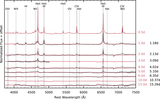
Caption: Figure 2.

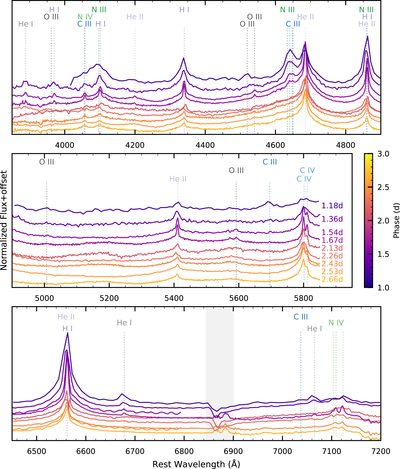
The evolution of SN 2023ixf from day 1.18 through day 3, colored by phase. Ions are labeled in each panel, and the phase is given in the middle panel. Emission lines from the low-ionization levels, He I, N III, C III, O III, and N IV (λ 5074 Å), disappear over the first 0.5 day of evolution while emission from high-ionization levels, N IV (λ λ7103, 7109, λ7122), He II (λ4685.5), and C IV (λ λ 5801.3, 5811.98 Å), increase in strength. Spectra are fit with a blackbody function and normalized, corrected for redshift, and offset for readability. In the bottom panel, the B-band telluric feature is marked with a gray shaded region.

Other Images in This Article
Copyright and Terms & Conditions

Additional terms of reuse