

Image Details
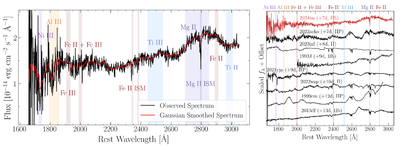
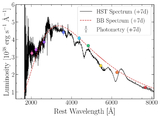
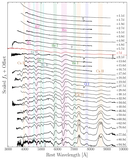
Caption: Figure 12.
Left: the δt = 7 days HST UV spectrum of SN 2024iss, with prominent features from both the SN and the host-galaxy interstellar medium (ISM) highlighted. The spectrum is corrected for redshift and extinction. Right: the δt = 7 days HST UV spectrum of SN 2024iss compared with the δt = 7 days spectrum of SN 2022acko (K. A. Bostroem et al. 2023), δt = 8 days spectrum of SN 2023ixf (E. A. Zimmerman et al. 2024), δt = 9 days spectrum of SN 1993J (K. S. de Boer et al. 1993; G. Sonneborn et al. 1993), δt = 9 days spectrum of SN 2021yja (S. S. Vasylyev et al. 2022), δt = 10 days spectrum of SN 2022wsp (S. S. Vasylyev et al. 2023), δt = 12 days spectrum of SN 1999em (E. Baron et al. 2000; A. Gal-Yam et al. 2008), and δt = 13 days spectrum of SN 2013df (S. Ben-Ami et al. 2015). All spectra are corrected for redshift and extinction.
Other Images in This Article
Show More
Copyright and Terms & Conditions
© 2026. The Author(s). Published by the American Astronomical Society.

