Image Details

Choose export citation format:

SN 2024iss: A Multiwavelength Exposé of a Type IIb Supernova with an Early-time Ultraviolet Spectrum and Shock-breakout Constraints

  • Authors: R. J. Yete, W. V. Jacobson-Galán, Ferdinand, L. Dessart, M. M. Kasliwal, K. W. Davis, A. L. Piro, V. A. Villar, I. Andreoni, K. Auchettl, K. C. Chambers, R. Chornock, M. W. Coughlin, D. A. Coulter, R. Dekany, R. J. Foley, O. D. Fox, L. Galbany, C. Gall, A. Gangopadhyay, J. A. Goldberg, G. Govindaraj, X. Guo, M. E. Huber, J. Castaneda Jaimes, J. Karcheski, R. Kaur, C. D. Kilpatrick, R. R. Laher, N. LeBaron, C.-C. Lin, R. Margutti, Y.-C. Pan, K. C. Patra, H. M. L. Perkins, P. J. Pessi, O. Pyshna, A. Rest, S. Romagnoli, S. Schulze, H. Sears, A. Sedgewick, M. R. Siebert, A. Singh, J. Sollerman, N. Sravan, S. Tinyanont, R. J. Wainscoat, Q. Wang, D. Warshofsky, Y. Yao, Y. Zenati

R. J. Yete et al 2026 The Astrophysical Journal 1009 .

  • Provider: AAS Journals

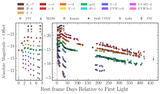
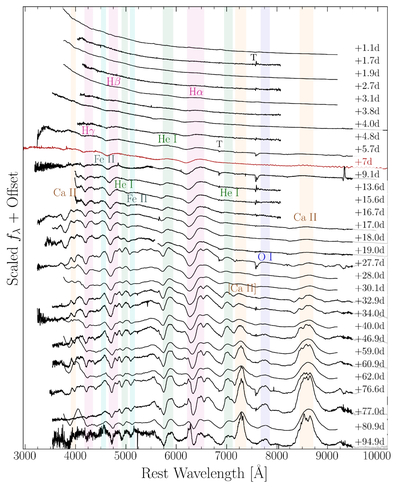
Caption: Figure 9.

The evolution of the optical spectra of SN 2024iss in the photospheric phase, ranging from δt = 1.1–94.9 days. Prominent spectral features and their corresponding elements are highlighted, and telluric absorption features are marked with “T.” The HST spectrum at δt = 7 days is shown in red. All spectra are corrected for redshift and dust extinction, scaled relative to their mean fluxes, and offset.

(The data used to create this figure are available in the online article.)

(The data used to create this figure are available.)

Other Images in This Article
Show More

Copyright and Terms & Conditions

Additional terms of reuse