

Image Details
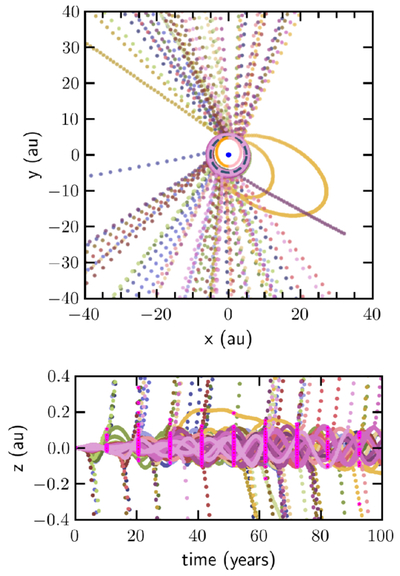
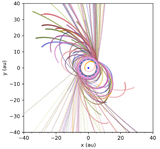
Caption: Figure 3.
Example of particles’ trajectories (top) and height over time (bottom), showing the behavior that produces particle ejections every period. Particles are ejected in the negative and positive vertical direction. They are ejected by the stellar wind when their height reaches a certain value, zh, which is left as a free parameter in the simulation. We choose the highest zh possible (i.e., a value close to the local minimum/maximum of the particle height over time). This ejection occurs in the orbital region close to the planet’s apocenter and pericenter. In this example, the planet ascends at apocenter and orbits counterclockwise. The particles launched toward –y are moving in the positive z-direction, and those moving toward +y are moving in the negative z-direction. This simulation includes a 0.6M⊙ star, a 2MJ planet, and 200 massless particles. The planet is initialized at aP = 4 au, eP = 0.3, iP = 30∘. The particles are uniformly distributed between 5.5 and 6 au on coplanar, circular orbits.
Other Images in This Article
Copyright and Terms & Conditions
© 2026. The Author(s). Published by the American Astronomical Society.

