

Image Details
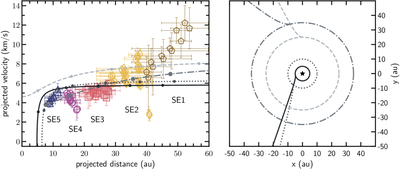
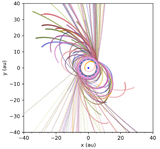
Caption: Figure 1.
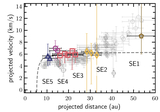
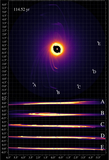
We simulate four particles with a different combination of initial distance from the star (Rd), stellar wind force (β), and ejection angle (θ), demonstrating how these parameters affect the projected speed at a given projected distance; line styles are consistent across panels. Left: projected speed and projected distance of the four particles and the five southeastern dust clumps SE5 (blue triangle), SE4 (purple circle), SE3 (pink square), SE2 (yellow diamond), SE1 (brown pentagon), calculated from Table 2 in A. Boccaletti et al. (2018). Each trajectory passes through the data points of at least two clumps, illustrating that particles on hyperbolic orbits due to stellar wind forces can reproduce the observed projected speeds at a range of distances, though no single trajectory fits all five clumps simultaneously. Filled circles along each trajectory are separated by 8.5 yr; note that these circles align with the projected distances of the observed clumps, motivating the idea that a planet with an ≈8 yr orbital period drives the periodic ejections. There is no planet included in these simulations. Right: top-down view of the same four particles in their initial circular orbits and their subsequent hyperbolic trajectories. Ordered from smallest to largest initial orbit, the parameters that determine the trajectories (Rd, β, θ) are: (5 au, 2, 1.06π), (10 au, 7, 5π/4), (25 au, 10, π/2), (35 au, 5, 1.14π/2), where θ = ω since Ω = f = 0. The ejection angle θ determines the direction in which particles are launched, which affects the projected speed as seen by an observer.
Other Images in This Article
Copyright and Terms & Conditions
© 2026. The Author(s). Published by the American Astronomical Society.

