

Image Details
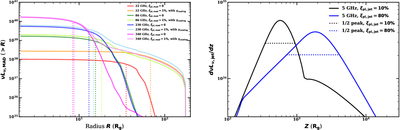
Caption: Figure 1.
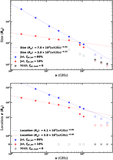
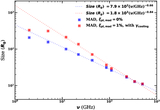
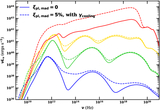
Left panel: cumulative monochromatic radiation distribution νLν,MAD( > R) (from infinity to radius R) of MAD, as a function of radius R. The BH mass is 109 M⊙, and the accretion rate at 200 Rg is ﹩{\dot{m}}_{0}=1\times 1{0}^{-4}﹩. As specified in color, several radio frequencies are considered, i.e., 22, 86, 230, 340 GHz. Two different electron populations are investigated, one for purely thermal electrons (ξpl,mad = 0), and the other for 1% nonthermal electrons (radiative cooling to those PL electrons considered self-consistently) (ξpl,mad = 1%). The dotted line with the same color marks the model-predicted radius of the MAD as observed at that frequency. Clearly, the radio size of MAD decreases with frequency, and a small fraction of PL electrons only slightly increases the radio size. Right panel: radiation distribution at 5 GHz along the jet direction z. Here the mass loss rate and the bulk Lorentz factor of the jet are, respectively, ﹩{\dot{m}}_{{\rm{jet}}}=8.1\times 1{0}^{-7}﹩ and Γjet = 10. Two different electron populations are considered, i.e., ξpl,jet = 10% (black solid) and 80% (blue solid). Theoretically the jet location in radio is defined at where it reaches its peak value, while the jet size is evaluated by the horizontal dotted line that intersects 1/2 of the peak value.
Other Images in This Article
Copyright and Terms & Conditions
© 2026. The Author(s). Published by the American Astronomical Society.

