

Image Details
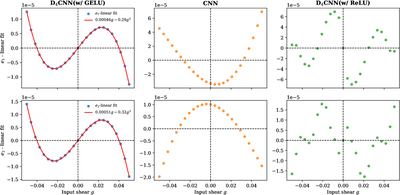
Caption: Figure 8.
Nonlinear response of the three models to applied shear. Galaxies with identical circular profiles but different input shear g are fed into the models. The linear response of the measured ellipticity is fitted and subtracted, and the residual ei − linear fit is plotted as a function of the input shear. The top and bottom rows correspond to the two ellipticity components e1 and e2, respectively. D4CNN (w/ GELU) (left column) exhibits an approximately cubic behavior with no visible quadratic component (the fitted curves are shown in red), consistent with the suppression of even-order terms expected from the imposed symmetry. In contrast, the CNN model (middle column) shows a clear parabolic trend, indicating the presence of second-order nonlinear terms arising from the lack of D4 equivariance. D4CNN (w/ RELU) (right column), while roughly preserving odd symmetry, displays larger scatter and higher-order nonlinear structures, likely due to the discontinuous gradient of the ReLU activation function.
Other Images in This Article
Copyright and Terms & Conditions
© 2026. The Author(s). Published by the American Astronomical Society.

