

Image Details
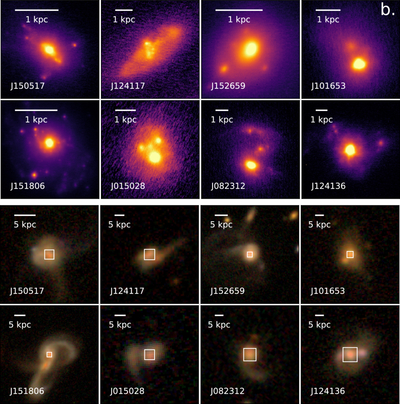
Caption: Figure 9.
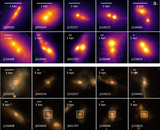
(a). Keck/NIRC2 and SDSS cutout images of the Primary Keck AO Merger Sample. The systems are divided into four subfigures according to their observed NIR morphology: (a) systems with two compact nuclei (i.e. apparent dual-nucleus systems); (b) systems that contain compact secondary sources whose morphologies are consistent with SF regions rather than distinct nuclear components; (c) systems with morphological features consistent with spiral arms or tidal tails; and (d) single-nucleus systems. In each subfigure the top panel shows the Keck/NIRC2 AO Kp-band cutout images and the bottom panel shows the corresponding SDSS gri color cutout images of the same targets. The white squares indicate the FOVs of the Keck/NIRC2 images. Images are oriented with north up and east to the left. Systems in panels (a) and (b) are arranged in order of increasing projected nuclear separation, while systems in panels (c) and (d) are arranged in order of increasing redshift. Although J124136 exhibits apparent substructure, it does not satisfy our adopted flux-ratio threshold and is therefore not classified as a substructure detection. More detailed descriptions of individual targets are provided in Appendix C.
Other Images in This Article
Show More
Copyright and Terms & Conditions
© 2026. The Author(s). Published by the American Astronomical Society.

