

Image Details
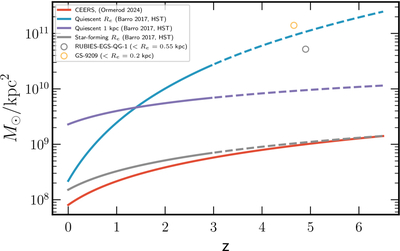
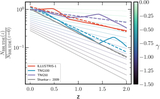
Caption: Figure 3.
Evolution of galaxy central surface density as a function of redshift. Lines are solid where measurements are available and dashed where the relations from G. Barro et al. (2017) are extrapolated to higher redshifts. It can be seen that the extrapolation of the star-forming sample is a good prediction of what is later observed in the CEERS (S. L. Finkelstein et al. 2023; K. Ormerod et al. 2024) observations obtained with JWST. The quiescent-galaxy extrapolation also predicts the two highest-redshift quiescent galaxies for which this density has been measured (A. C. Carnall et al. 2023; A. de Graaff et al. 2025). We use the 1 kpc extrapolation to predict the evolution of the central galaxy density.
Other Images in This Article
Copyright and Terms & Conditions
© 2026. The Author(s). Published by the American Astronomical Society.

