

Image Details
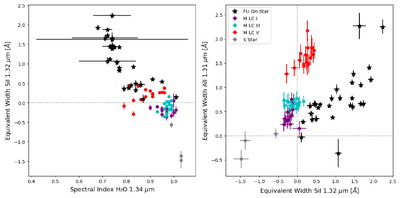
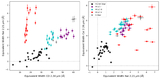
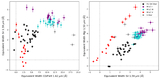
Caption: Figure 9.
FUOr diagnostics in the J band. On the left, a plot of H2O 1.34 μm spectral index vs. Si I 1.32 μm EW, comparing a strong molecule with an atomic feature. The H2O 1.34 μm signature (unity is no detectable H2O) is more prominent at lower temperatures and is weakly dependent on surface gravity, being stronger in dwarfs than in lower gravity giants. FUOrs are strong in both H2O 1.34 μm and Si I 1.32 μm absorption, and stand apart from M-type stars at all luminosities, as well as S-type sources (which may be poorly measured). On the right, a plot of Si I 1.32 μm vs. Al I 1.31 μm EWs, comparing two atomic features that are right next to one another in the spectra. The Al I 1.31 μm feature has a strong surface gravity dependence (being stronger in dwarfs than in giants) and grows in strength toward the coolest M-type temperatures. The Si I 1.32 μm feature is also stronger in dwarfs than in giants. Similar to the case of Si I 1.59 μm, FUOrs have generally stronger Si I 1.32 μm than either dwarfs or giants and weaker Al I 1.31 μm than M dwarfs, though they somewhat overlap with the M giants.
Other Images in This Article
Show More
Copyright and Terms & Conditions
© 2026. The Author(s). Published by the American Astronomical Society.

