

Image Details
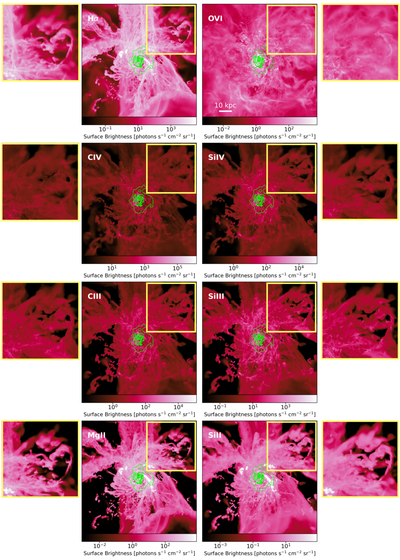
Caption: Figure 2.
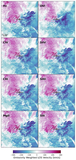
Face-on surface brightness maps of the Squall halo for eight ions with emission lines in the UV/optical: Hα, Mg II, Si II, Si III, C III, C IV, and O VI. The box sizes cover 100 kpc fields of view. Each panel uses an independent color scale spanning 7 orders of magnitude in surface brightness (from 10−8 to 10−1 of the maximum emission value in that panel), chosen to highlight the morphology of emission structures in each ion rather than to compare absolute surface brightness between ions. The H I disk has been removed to isolate CGM emission; green contours indicate where the disk was. These maps highlight the multiphase nature of the CGM, as different ions trace different physical structures and temperatures. The zoom-in panels emphasize key differences in morphology across ions. These comparisons demonstrate that no single emission line fully captures the CGM’s complexity. Each ion offers a distinct view of its structure and thermodynamic state. Observing multiple UV lines is essential for building a complete, multiphase picture of the circumgalactic medium.
Other Images in This Article
Show More
Copyright and Terms & Conditions
© 2026. The Author(s). Published by the American Astronomical Society.

