

Image Details
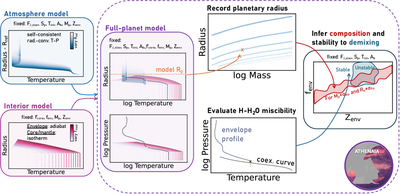
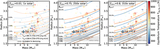
Caption: Figure 2.
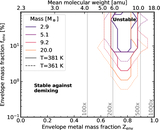
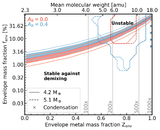
Illustration of the workflow for the construction of coupled interior-atmosphere models with ATHENAIA. For each composition, atmosphere models are calculated with SCARLET (top left) and interior models following D. Thorngren & J. J. Fortney (2019). We couple them with ATHENAIA by finding the Rref (atmosphere model) and ﹩{T}_{{\rm{mod}}}﹩ (interior model) that minimize δTPR (see Equation (5)). The radius at 20 mbar is extracted to construct constant-composition mass–radius curves, while the T–P profile of the envelope is used to evaluate the stability to demixing by comparing to the corresponding H-H2O coexistence curve (dashed). Finally (right panel), given planetary mass and radius, the range of potential compositions is mapped to fenv − Zenv space (red) and compared to the map of conditions where envelopes are (un)stable against demixing (blue).
Other Images in This Article
Show More
Copyright and Terms & Conditions
© 2026. The Author(s). Published by the American Astronomical Society.

