

Image Details
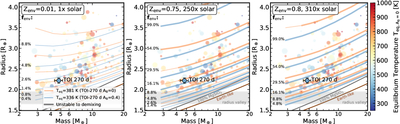
Caption: Figure 9.
Mass–radius diagram of planets across the sub-Neptune size range (circles, color encodes equilibrium temperature) and their susceptibility to demixing for Zenv = 0.01 (left, 1× solar metallicity), 0.75 (middle, 250× solar metallicity), and 0.8 (right, 310× solar metallicity). Circle sizes encode the favorability of planets to transmission spectroscopy via the transmission spectroscopy metric (E. M.-R. Kempton et al. 2018). The position of TOI-270 d in mass–radius space is indicated by the opaque black-outlined circle, and constant-composition curves for an Earth-like and a 100% MgSiO3 rocky composition (L. Zeng et al. 2016) are shown in gray and brown. The approximate position of the “radius valley” (B. J. Fulton et al. 2017) separating sub-Neptunes from the smaller rocky super-Earths is shown as the gray shaded area. For models of sub-Neptunes with gas envelopes, we show the ATHENAIA mass–radius relationships for various envelope mass fractions (labeled in each panel), for each envelope metallicity, assuming Teq = 336 K (blue) or 381 K (orange). Thicker curves indicate conditions unstable to demixing. Over the 330–380 K temperature regime explored, demixing impacts sub-Neptunes with metal-rich envelopes across their entire range of masses and radii.
Other Images in This Article
Show More
Copyright and Terms & Conditions
© 2026. The Author(s). Published by the American Astronomical Society.

