

Image Details
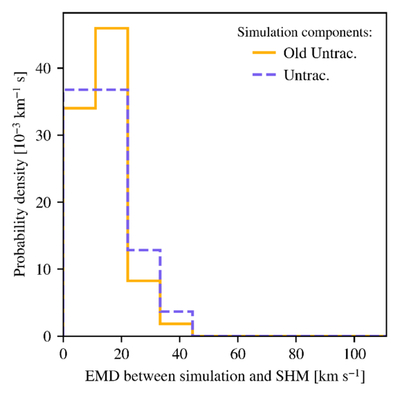
Caption: Figure 3.
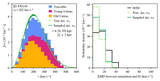
EMDs between the SHM and the speed distribution of the Old Untraceable DM (solid yellow) or the Untraceable components combined (dashed purple). The Old Untraceable component on its own is well described by a Maxwell–Boltzmann, with an EMD of ﹩1{3}_{-6}^{+8}\,\,\rm{km}\,\,{\,\rm{s}\,}^{-1}﹩, while the Young Untraceable component alone (not shown in the figure) is not, lying ﹩6{5}_{-32}^{+52}\,\,\rm{km}\,\,{\,\rm{s}\,}^{-1}﹩ from the SHM. However, since the Young Untraceable component is typically a small fraction of the DM in the solar annulus, combining the Old and Young Untraceable components together is still well modeled by the SHM, with an EMD of ﹩1{3}_{-6}^{+13}\,\,\rm{km}\,\,{\,\rm{s}\,}^{-1}﹩.
Other Images in This Article
Show More
Copyright and Terms & Conditions
© 2026. The Author(s). Published by the American Astronomical Society.

