

Image Details
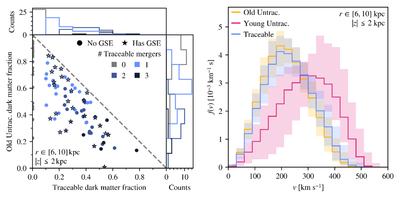
Caption: Figure 1.
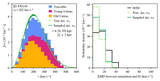
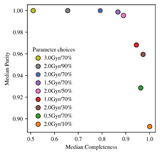
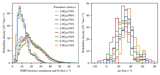
(Left) Fraction of DM in the solar annulus (6–10 kpc in cylindrical radius and height ∣z∣ ≤ 2 kpc) originating from Traceable mergers vs. the fraction accreted prior to redshift 3 (Old Untraceable DM), across the 98 MW analogs. Points are colored by the number of Traceable mergers and shaped by the presence (star markers) or absence (circle markers) of a GSE-like event in that galaxy’s history. Marginal histograms show the distribution of each quantity across the sample, given the number of Traceable mergers. For systems with one Traceable merger, ﹩5{8}_{-17}^{+12} \% ﹩ of the DM in the solar annulus is Old Untraceable, while ﹩1{8}_{-5}^{+15} \% ﹩ is Traceable. The remaining ﹩2{1}_{-12}^{+11} \% ﹩ is contributed after redshift three but lacks a substantial population of luminous tracers (Young Untraceable). (Right) Speed distributions for the three DM components in the solar annulus: Old Untraceable (yellow), Young Untraceable (magenta), and Traceable (blue). The solid line represents the median probability density, while shaded regions indicate the 16th–84th percentile range across the sample. While the Young Untraceable component exhibits greater halo-to-halo variance and is biased toward higher speeds, it typically represents a small fraction of the total Untraceable DM, such that the combined distribution is well described by a Maxwell–Boltzmann profile. The Traceable component can be modeled using the kinematics of the associated stellar debris. The DM components (Old Untraceable, Young Untraceable, and Traceable) are defined in Section 2.2.
Other Images in This Article
Show More
Copyright and Terms & Conditions
© 2026. The Author(s). Published by the American Astronomical Society.

