

Image Details
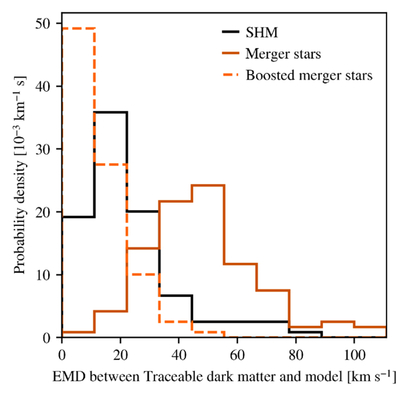
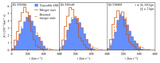
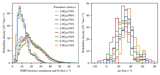
Caption: Figure 6.
EMDs between the speed distributions of Traceable DM and the stars accreted from the same merger, across all 108 Traceable mergers. The EMD between the DM and the uncorrected stellar distributions (solid orange) is ﹩4{7}_{-15}^{+19}\,\,\rm{km}\,\,{\,\rm{s}\,}^{-1}﹩. The EMDs, after applying the boost described in Equation (5) to the stellar velocities, are shown as Boosted stars (dashed orange). The boost reduces the EMD to ﹩1{0}_{-5}^{+11}\,\,\rm{km}\,\,{\,\rm{s}\,}^{-1}﹩, indicating that the boosted stars serve as better tracers for the underlying DM speed distribution. The boosted stellar tracer model is also better than the SHM (solid black), which has an EMD of ﹩1{8}_{-8}^{+16}\,\,\rm{km}\,\,{\,\rm{s}\,}^{-1}﹩ from the DM speed distribution.
Other Images in This Article
Show More
Copyright and Terms & Conditions
© 2026. The Author(s). Published by the American Astronomical Society.

