

Image Details
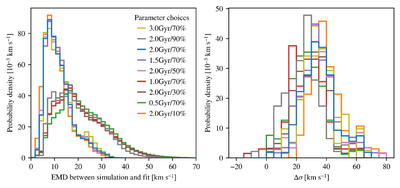
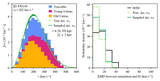
Caption: Figure A3.
Comparison of reconstruction performance across the nine merger-tracking parameter sets, labeled by the time window (in Gyr) and the fraction of snapshots that a particle must be bound to be considered tagged (as a percentage). (Left) Distribution of EMDs between the exact DM speed distributions and the sampled–﹩{\rm{\Delta }}\sigma ,\,{w}_{{\rm{tr}}}﹩ reconstructions (see Figure 7) for all Traceable mergers across the 98 MW analogs. While low-purity choices of parameters (i.e., those with smaller time windows or less restrictive fractions) tend to have larger EMDs—and therefore less accurate reconstructions—our fiducial choice is among the most accurate, with a few comparable algorithms. (Right) Distribution of the boost factor Δσ (Equation (6)) across all Traceable mergers for each parameter set. The results here are qualitatively the same regardless of the choice of DM tagging parameters. There is consistently an offset between the DM and stellar velocity dispersions, suggesting that this offset is a physical result and not due to our tagging procedure.
Other Images in This Article
Show More
Copyright and Terms & Conditions
© 2026. The Author(s). Published by the American Astronomical Society.

