

Image Details
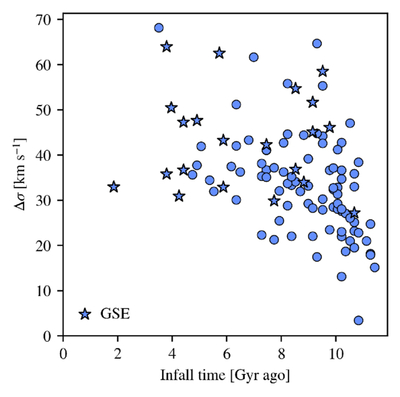
Caption: Figure B2.
Boost factor Δσ as a function of the infall time for all Traceable mergers (circles). GSE-like mergers are highlighted separately (stars). Mergers with earlier infall times tend to show smaller dispersion offsets. Those with infall times greater than 11 Gyr have a median offset of ﹩{9}_{-5}^{+2}\,\,\rm{km}\,\,{\,\rm{s}\,}^{-1}﹩, while those with infall times less than 11 Gyr have a median offset of ﹩1{5}_{-7}^{+6}\,\,\rm{km}\,\,{\,\rm{s}\,}^{-1}﹩. This trend is consistent with the mechanism highlighted in Figure B1. When mergers fall in earlier, both their DM and stars are deposited at smaller radii because the MW itself was smaller, reducing the difference in potential energies and thus the dispersion offset.
Other Images in This Article
Show More
Copyright and Terms & Conditions
© 2026. The Author(s). Published by the American Astronomical Society.

