

Image Details
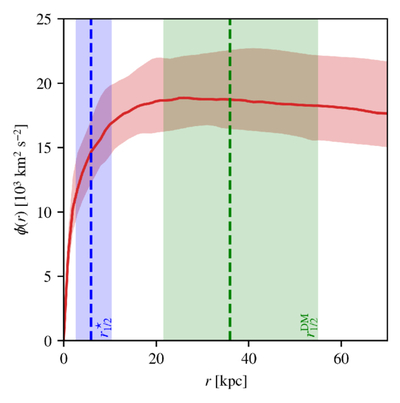
Caption: Figure B1.
Gravitational potential per unit mass, ϕ(r), at redshift zero across our 98 MW analogs (solid red, with shaded regions indicating the 16th–84th percentiles across the analogs). The vertical bands indicate the galactocentric spherical radii that enclose half of the DM debris (﹩{r}_{1/2}^{{\rm{DM}}}﹩, green) and half of the stellar debris (﹩{r}_{1/2}^{\star }﹩, blue). The stars are deposited at radii of ﹩{6}_{-3}^{+4}﹩ kpc, while the DM is further from the galactic center, at ﹩3{6}_{-14}^{+19}﹩ kpc. The DM debris typically has higher orbital energy and exhibits a larger velocity dispersion than the stellar debris, yielding the offset shown in Figure 5.
Other Images in This Article
Show More
Copyright and Terms & Conditions
© 2026. The Author(s). Published by the American Astronomical Society.

