

Image Details
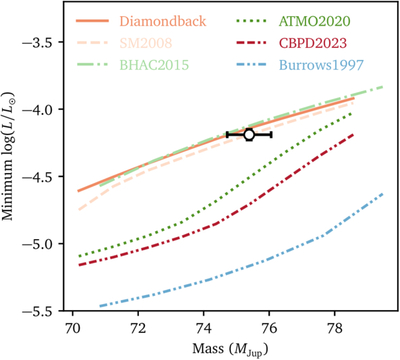
Caption: Figure 12.
The minimum luminosity reached along the brown dwarf cooling tracks is shown as a function of mass. This minimum luminosity corresponds to the luminosity at the 10 Gyr age in the cooling tracks. Diamondback and SM2008 go beyond 10 Gyr, but we truncate at 10 Gyr for our tests. The evolutionary models populate only the region above the plotted lines, and the circle indicates the observed values for HR 7672B. The minimum luminosities of the Diamondback and BHAC2015 models are only marginally consistent with the observations (model-coverage fractions of 16% and 24%, respectively), and the SM2008 models may also be in tension (50% model-coverage fraction), suggesting that the stellar/substellar boundary in these models is too low in mass.
Other Images in This Article
Show More
Copyright and Terms & Conditions
© 2026. The Author(s). Published by the American Astronomical Society.

