

Image Details
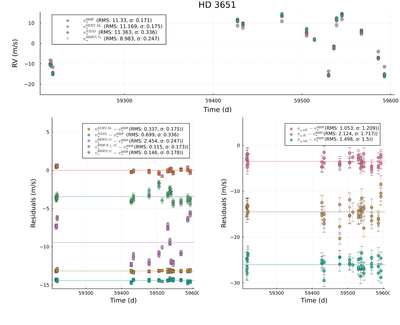
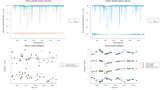
Caption: Figure 16.
Top: the final RV reduction of ﹩{v}_{\star }^{{\mathtt{SSOF}}}﹩ (blue) for HD 3561 combining the velocity measurements from 77 SSOF order models resulting in a 49% tighter SMP when compared to the NEID DRP’s CCF-based RVs (﹩{v}_{\star }^{{\rm{NEID}}}﹩, green) and a similar SMP and RV rms when compared to SERVAL’s template-matching RVs (﹩{v}_{\star }^{{\rm{SERV\; AL}}}﹩, orange). ﹩{v}_{\star }^{{\mathtt{SSOF}}(5,5)}﹩ (purple) has a lower rms, but only by taking out a portion of the planetary signal. All RV time series are shown with their corresponding 1σ error bars. Bottom left: the residual time series for ﹩{v}_{\star }^{{\rm{SERV\; AL}}}﹩ (orange), ﹩{v}_{\star }^{{\rm{NEID}}}﹩ (green), and several other versions of ﹩{v}_{\star }^{{\mathtt{SSOF}}}﹩. Only a few SSOF models used in ﹩{v}_{\star }^{{\mathtt{SSOF}}}﹩ used stellar variability so ﹩{v}_{\star }^{{\mathtt{SSOF}}({K}_{\oplus },0)}﹩ is functionally identical to ﹩{v}_{\star }^{{\mathtt{SSOF}}}﹩. Ignoring telluric variability only adds 15 cm s−1of variability. Bottom right: the residual time series for the highlighted SSOF order models. The residual velocities from the KO (pink) H2O and O2 separating order (dark orange), and Fe I variability order (seafoam green) are all essentially consistent with white noise.
Other Images in This Article

Show More
Copyright and Terms & Conditions
© 2026. The Author(s). Published by the American Astronomical Society.

