

Image Details
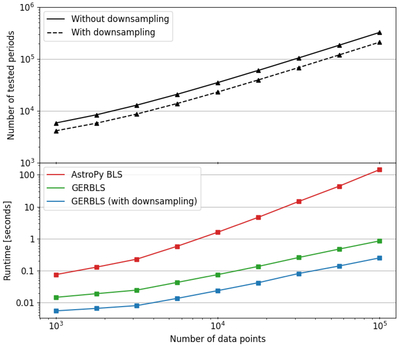
Caption: Figure 3.
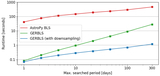
Top: number of trial periods searched in a period grid generated by GERBLS, as a function of the number of data points. In each case, time sampling of the input data was set to 10 minutes, and periods between 0.1 and 10 days were searched. The solid line and dashed line depict results with automatic downsampling turned on or off, respectively. The number of periods that need to be searched grows with the number of data points due to the corresponding increase in the total time baseline of the data. Bottom: average BLS runtime as a function of the number of data points. Three algorithms are compared: a brute-force AstroPy BLS (red), FFA-based GERBLS (green), and GERBLS with automatic data downsampling (blue). The measured complexity of GERBLS is close to ﹩O(n\mathrm{log}n)﹩ while that of the brute-force BLS is close to O(n2). In all cases, GERBLS outperforms AstroPy by an order of magnitude in runtime.
Other Images in This Article
Copyright and Terms & Conditions
© 2026. The Author(s). Published by the American Astronomical Society.

