

Image Details
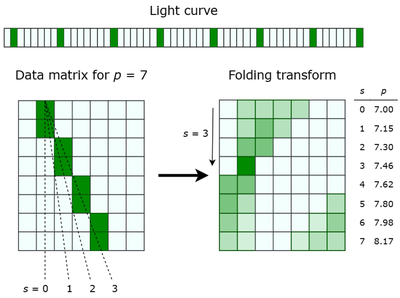
Caption: Figure 1.
A high-level illustration of the FFA. In order to phase-fold the discretely sampled light curve shown at the top with a period of p = 7, the data are first transformed into a two-dimensional matrix with m rows and p = 7 columns (left panel). In both cases, the presence of an actual transit with a period of ∼7.5 is denoted with solid dark green squares. Since the true period is longer than p = 7, the transit appears to drift right between the different rows of the matrix. The FFA generates an m × p folding transform from the two-dimensional data matrix, where the first row corresponds to a phase-fold of the initial light curve at a period of p = 7 obtained by adding up the rows in the data matrix. Each subsequent row s is obtained by introducing a total of s leftward shifts during the row addition process, corresponding to a total drift s of the transit signal between the first and last rows of the data matrix. This can be thought of as summing up (i.e., phase-coherently integrating) the rows of the data matrix along the dotted lines. As a result, each row of the resulting folding transform contains a phase-fold of the light curve at a different period between p and p + 1 (approximately), calculated in the rightmost column “p.” Crucially, folding transforms can be generated from data matrices in a divide-and-conquer algorithm, efficiently yielding a large number of phase-folded light curves (in this case, 8) per data matrix. The calculation of a BLS spectrum then involves sequentially calculating a folding transform for every integer value of p between some desired minimum and maximum search period.
Other Images in This Article
Copyright and Terms & Conditions
© 2026. The Author(s). Published by the American Astronomical Society.

