

Image Details
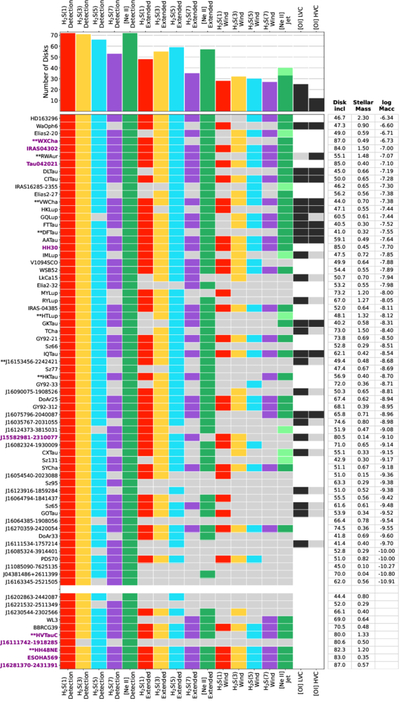
Caption: Figure 7.
Figure summarizing which of the five analyzed spectral lines are detected, spatially extended, and exhibit outflow-like signatures. For example, when H2 S(1) is detected toward a given source, the corresponding block is highlighted in red; when it is not detected, the block is shown in gray. For [Ne II] jet classification, the additional lighter shade of green highlights the cases showing “extended emission with a jetlike bulk velocity,” whereas the darker shade highlights “extended emission with a jetlike velocity map” (see Section 3.3 for the classification criteria). The [O I] low-velocity component (LVC) and high-velocity component (HVC) detections are compiled from the literature; white blocks indicate that no published data are available for that source, while gray blocks indicate that data exist but the corresponding component is absent in the spectrum. The total number of sources with published [O I] detections is equivalent to the number of sources showing [O I] LVCs, as this component was detected toward all but one source (RW Aur A). The sources are ordered from top to bottom by decreasing mass accretion rate and, when not available, by increasing disk inclination. Sources whose names are prefixed with “**” denote multiple systems with companion(s) within the same FOV, while sources whose names are displayed in purple are highly inclined. To the right side, key stellar and disk properties of each source are provided, references to which can be found in Table 2.
Other Images in This Article
Show More
Copyright and Terms & Conditions
© 2026. The Author(s). Published by the American Astronomical Society.

