

Image Details
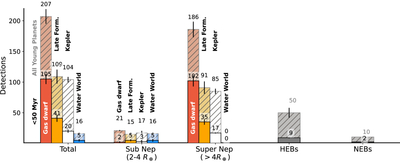
Caption: Figure 9.
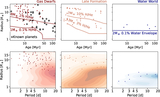
Expected planet yield of a simultaneous NUV, optical, and NIR wide-field survey, assuming a 20 cm aperture optical telescope and 30 day stare durations per field over a 2.5 yr primary mission. Planet yields based on the gas-dwarf hypothesis from J. G. Rogers (2025) are plotted in red, late-stage formation gas dwarfs in orange (E. J. Lee et al. 2022), the water-world hypothesis from J. G. Rogers (2025) in blue, and based on steady-state Kepler statistics in black. The planet yield for young planets (<50 Myr) is plotted in solid colors, and that of all ages about kinematically associated stars in hashed light colors. A small number of super-Earths (<2 R⊕) are detected in some of the simulations, and account for the remaining planets. The expected astrophysical false-positive rates are also reported, with all planet-like false positives about 50 Myr or younger stars marked by the solid bars, and those about all young kinematically associated stars in hashed bars. Only hierarchical eclipsing binaries (HEBs) and nearby eclipsing binaries (NEBs) are expected to contribute toward the false-positive statistics of EVE.
Other Images in This Article
Show More
Copyright and Terms & Conditions
© 2026. The Author(s). Published by the American Astronomical Society.

