

Image Details
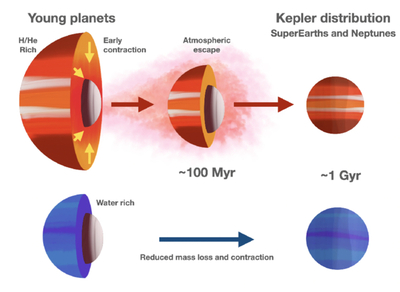
Caption: Figure 1.
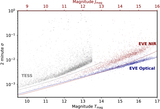
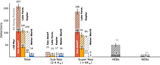
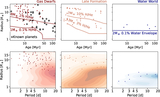
The small planet population can be explained by competing hypotheses. Planets may form with substantial, low mean-molecular-weight atmospheres (gas dwarfs). Depending on when the gas envelope was accreted, these planets may undergo rapid radial evolution during the first 100 million years due to the combined atmospheric escape effects of boil-off, contraction, and photoevaporation. Planets may also form with volatile-rich, higher mean-molecular-weight envelopes (water worlds). Such planets undergo far less radial evolution within this time frame. The densities and radii of two populations are degenerate by the mature ages sampled by the Kepler and TESS missions. Targeting planets around known star-forming regions and young associations can statistically differentiate between these two scenarios.
Other Images in This Article
Show More
Copyright and Terms & Conditions
© 2026. The Author(s). Published by the American Astronomical Society.

