

Image Details
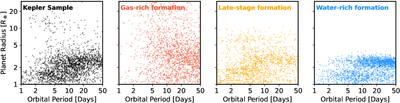
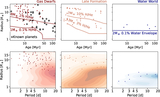
Caption: Figure 4.
The input sample of the modeled planet population for our mission simulations. These models show the underlying planet population drawn from evolution models from J. G. Rogers (2025) and E. J. Lee et al. (2022), for the gas-dwarf (red), late-stage gas accretion (orange), and water-world (blue) scenarios. Each randomly drawn planet has evolved to correspond with the ages of its parent stars. No selection biases have been applied to the plotted distributions. Note that the simulated planet populations do not include true gas giants by design, and none of the simulated planets will form eventual hot Jupiters and warm Jupiters. The Kepler planet distribution is plotted for comparison.
Other Images in This Article
Show More
Copyright and Terms & Conditions
© 2026. The Author(s). Published by the American Astronomical Society.

