

Image Details
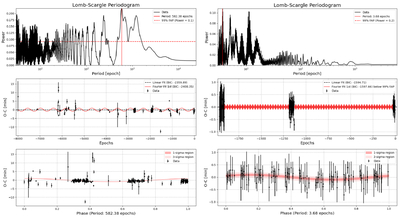
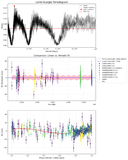
Caption: Figure 6.
Top: Lomb–Scargle periodograms for the combined midtransit times (left) and the TESS-only photometry (right). The orbital period of the planet is 1 epoch (0.94145252 days). The combined dataset exhibits several peaks above the 99% false alarm probability (FAP; Power ≈ 0.1), which are sensitive to sampling rates and represent significant aliasing artifacts from inhomogeneous ground-based observations. In contrast, the TESS-only periodogram reveals no significant signals above the FAP, with the strongest peak at 3.68 epochs. Middle: O − C diagrams for the combined and TESS-only measurements. Both cases show similar Bayesian Information Criterion (BIC) values for linear and Fourier fits. Bottom: phase-folded O − C diagrams. The lack of consistency between the primary peaks of the combined (582.38 epochs or 548.28 days) and TESS (3.68 epochs or 3.46 days) datasets further indicates that these signals are noise-driven aliases rather than coherent perturbations from a second planet.
Other Images in This Article
Copyright and Terms & Conditions
© 2026. The Author(s). Published by the American Astronomical Society.

