

Image Details
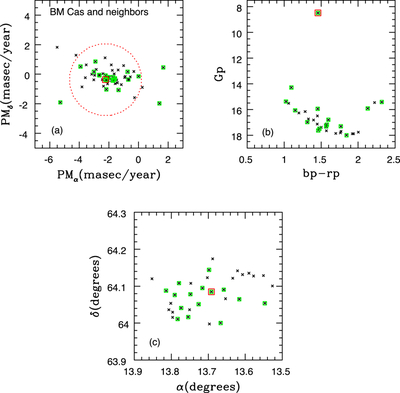
Caption: Figure 3.
Panel (a): proper motions of stars with G < 18 that have projected offsets ≤0﹩\mathop{.}\limits^{\unicode{x000b0}}﹩085 (∼6 pc) from BM Cas. The black crosses are sources in the 2σ sample, while the green squares mark sources in the 1σ sample. The BM Cas data points are shown as a red square. BM Cas is near the center of the proper motion measurements, indicating that its space motions are typical for this part of the Galaxy. The circle marks the region of this diagram that is used to identify stars that were extracted to construct panels (b) and (c). Panel (b): the CMD of objects that fall within the circle in panel (a). The photometric measurements are from the GAIA DR3 archive. BM Cas is much brighter than other stars in this sample, which is a characteristic that is common to intermediate mass interacting binary systems (T. J. Davidge 2023). There is an absence of bright blue stars that would be indicative of a population of young massive stars, although there are objects with bp − rp > 2 that are probable PMS stars. Panel (c): the projected on-sky distribution of objects with Gp < 18 that have distances and proper motions similar to BM Cas. The closest companion to BM Cas has a projected offset of ∼0.5 pc. The stars that are possible PMS objects in panel (b) are in the lower right-hand corner of this plot, and so have projected offsets of many parsecs from BM Cas.
Other Images in This Article
Show More
Copyright and Terms & Conditions
© 2026. The Author(s). Published by the American Astronomical Society.

